
Delivering a fit-out project within a live environment presents a very different set of challenges to working on an empty site. The space is not simply a construction zone – it remains operational, often supporting staff, customers or residents whose daily routines cannot be paused while works take place.
In this context, the role of a contractor extends beyond delivery. It becomes a question of control and sensitivity to the environment itself. Minimising disruption is not a secondary objective but is central to the success of the project.
Understanding the Complexity of Live Environments
A live environment introduces constraints that do not exist in traditional construction settings. Noise, dust, access and safety all become more complex when people remain on site throughout the programme. Even minor disruption can affect productivity or operational continuity.
For many organisations, closing temporarily is not a viable option. This means that fit-out works must be carefully planned and executed around ongoing activity, often requiring a more considered and flexible approach.
Planning and Phasing with Precision
Successful delivery begins with planning. In live environments, this often involves breaking the project into clearly defined phases, allowing different areas to remain operational while others are being developed.
Zoning a workspace and sequencing works accordingly helps reduce overlap between construction activity and day to day operations. It also allows for a more controlled programme, where disruption can be anticipated and managed rather than reacted to.
In many cases, more disruptive works are scheduled outside of normal operating hours. Evening or weekend working can significantly reduce the impact on staff and customers, particularly where noise or service interruptions are unavoidable.
Communication as a Core Principle
Clear communication is one of the most important elements of any live environment project. Without it, even well planned work can create uncertainty and frustration for those affected.
Regular updates, clear timelines and visibility over upcoming works help ensure that all stakeholders remain informed. This includes not only the client team but also staff, tenants or building users who may be directly impacted.
A transparent approach builds trust and allows potential issues to be addressed early, rather than becoming larger problems later in the programme.
 Managing Noise, Dust and Safety
Physical disruption must be carefully controlled throughout the project. Noise, dust and vibration are often the most visible aspects of construction activity, and without proper management they can quickly become a source of concern.
Modern fit-out projects use a range of measures to contain these factors, including acoustic barriers, sealed work zones and air filtration systems. The aim is to isolate construction activity as far as possible while maintaining a safe and clean environment for those on site.
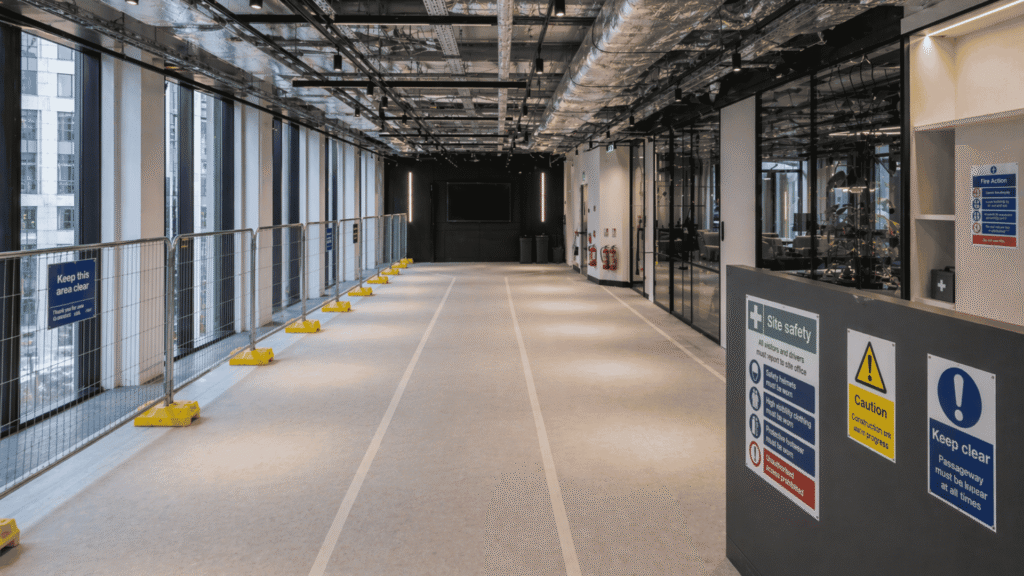
Safety remains a constant priority. Clear separation between construction areas and operational spaces is essential, supported by signage, controlled access and well defined routes for movement within the building.
Coordination and Flexibility
No two live environment projects are identical. Each site presents its own operational demands, access limitations and logistical considerations. As a result, coordination across all parties becomes critical.
This includes alignment between contractors, consultants, building management and the client team. Regular coordination ensures that changes can be managed effectively and that the programme remains on track.
Flexibility also plays an important role. Live environments are dynamic, and the ability to adapt to unforeseen challenges without compromising quality or safety is a defining characteristic of successful delivery.
A Measured Approach to Delivery
Minimising disruption is not achieved through a single action. It is the result of consistent decisions made throughout the project, from initial planning through to final handover.
A well delivered fit-out in a live environment should feel controlled and considered. Operations continue, stakeholders remain informed, and the impact of construction is carefully managed rather than imposed.
For clients, this approach protects productivity and reputation. For contractors, it reflects a deeper understanding of how buildings are used in practice, not just how they are built.
JPS Projects specialises in delivering fit-out projects within live environments, combining careful planning with a measured approach to minimise disruption; for further information or to discuss a project, please get in touch.