
A fire remediation programme is won or lost on survey quality, sequencing and the evidence you hand over at the end.
Retrofitting sprinklers and firestopping in an occupied building is mostly a planning exercise. The fewer times you enter each home, the faster the programme moves.
The record of the work matters as much as the work itself. It is what a landlord shows the regulator, the insurer and the next fire risk assessor. There has been plenty written about why fire safety in residential buildings matters, including our earlier piece on fire compliance in social housing, which covers what the Building Safety Act and Fire Safety Act ask of landlords. Less gets said about what the work looks like once a contractor is on site.
We are currently on site at Abbots Wood with Your Housing Group, delivering £2.3 million of fire remediation works. It is a priority building, and the scope covers firestopping, sprinkler installation and wider fire safety works across the whole building. So rather than another piece on regulation, here is how a programme like this runs, from first survey to final sign off.

It starts with the survey, not the spec
A fire risk assessment tells you where the problems are likely to be. An intrusive survey tells you what is really there. Opening up ceilings, risers and service voids before the programme is fixed means surprises turn up in week one, when they are cheap to deal with, rather than halfway through a block.
Every finding is logged by location and photographed. That log becomes the scope, the programme and, eventually, the handover record.
Firestopping: finding every gap
Most firestopping defects come from decades of other work. A new cable here, a replaced pipe there, each one punching a hole through a fire rated wall or floor that nobody sealed properly afterwards.
The fix itself is rarely difficult. The discipline is in finding every penetration, using a tested system that suits the substrate and the service passing through it, and recording each one. Location, product, system reference, before and after photos. A seal nobody can prove was installed correctly is only slightly better than no seal at all.
That is why our firestopping is third party certified under our FIRAS accreditation. An independent body audits our installations, and the client receives a certificate of conformity for the work, so the proof doesn’t rest on our word alone.
Sprinklers in a building people live in
Sprinklers have been required in new blocks of flats over 11 metres since 2020. Retrofitting them into an existing, occupied building is a different job altogether.
Pipework must be routed through communal areas and into every flat, then boxed in neatly. Water supply, tanks and pumps need space that the original building never planned for. Routes and finishes are agreed with the client up front, so residents are not asked to make decisions on the doorstep.
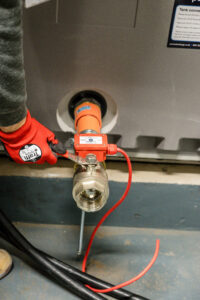
The aim is simple: get in, do the work, do it well and leave the home as residents would expect to find it.
Construction in occupied buildings: fewer visits per home
Firestopping, sprinkler installation, fire doors, making good and decoration all happen in the same homes. Left to run separately, that could mean five different teams knocking on the same door.
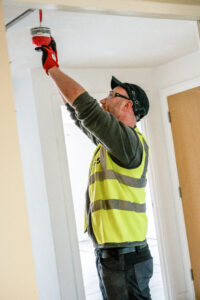
Sequencing trades so each flat is visited as few times as possible is where most of the programme is saved. It also makes life easier for residents, who deal with one team, one resident liaison officer and one set of appointment letters. Residents who know what is happening and why are far more likely to be in when you need them.
Handover is the evidence
When the last flat is signed off, the client should be left with a complete picture of what was done and where. That means as built drawings, product data, photo logs for every firestopping location, FIRAS certificates of conformity for the firestopping, and test and commissioning certificates for the sprinkler system.
For higher risk buildings this feeds directly into the golden thread of building information the Building Safety Act requires. For every other building, it is still the record a landlord will reach for when the regulator, an insurer or the next fire risk assessor asks how they know the building is safe.
Questions worth asking your contractor
Not all live environment construction contractors work the same way. If you have a remediation programme coming up, these questions will tell you a lot about how it will run:
- How will you survey before the programme is fixed?
- Is your firestopping third party certified?
- How will each firestopping location be recorded?
- How many times will you need to enter each home?
- Who is the residents’ point of contact?
- What exactly will we receive at handover?
Talk to us
JPS Projects is a fire compliance contractor working with housing associations and local authorities across the UK, delivering firestopping, sprinkler installation, fire doors and compartmentation works in occupied buildings. The same approach runs through our work as a government building contractor and across wider construction in regulated environments, from secure estates to healthcare. If you are planning a programme or working through a backlog, we would be glad to talk it through.